
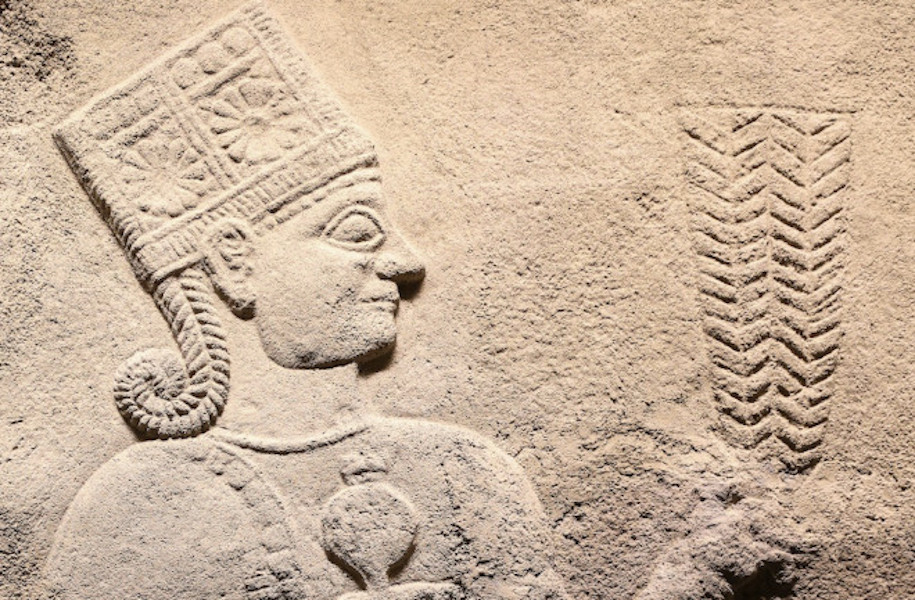
In 2500 B.C.E. Kubaba of Kish (Sumerian:𒆬𒀭𒁀𒌑) the extraordinary queen of ancient Sumer, now modern Iraq, ruled her kingdom. Besides successfully leading her people she stands out as the only woman on the Sumerian King List (SKL). She is also mentioned as a ruler—a title usually reserved for men. Referred to as Lugal, meaning “king” in Sumerian, which is unusual since there was no feminine equivalent. Throughout her long reign over Sumer Kubaba served as a queen in her own right with no male consort ruling with her.
She is credited with strengthening the foundation of Sumer and enjoying a long prosperous reign. Eventually, she passed the torch of power to her son, Puzur-Suen, who became the king. This makes Kubaba the grandmother of Ur-Zababa, a legendary adversary of the historical figure Sargon of Akkad.

Her background, like other tales of unusual figures assuming royal roles, is treated as fantastical. The legend of Kubaba claims that she rose from a lowly innkeeper through the social classes to become queen. This story follows similar tales of rags-to-riches such as the fuller Susuda, the sailor Mamagal, and the stone worker Nanniya.
Kubaba’s story adds an intriguing twist to ancient history, challenging conventional notions of power and gender.
- Resources
- Hawkins, John D. (1983), “Kubaba A. Philologisch · Kubaba A. Philological”, Reallexikon der Assyriologie, retrieved 2023-05-20
- Marchesi, Gianni (2010). “The Sumerian King List and the Early History of Mesopotamia”. Ana turri gimilli: studi dedicati al padre Werner R. Mayer, S.J., da amici e allievi. Quaderni di Vicino Oriente. Università di Roma La Sapienza. Retrieved 2023-05-19.
- Stol, Marten (2016). Women in the Ancient Near East. De Gruyter. doi:10.1515/9781614512639. ISBN 978-1-61451-263-9.
 No Dead White Men